Talk
Equine Grass Sickness seminar
Veterinary

Equine Grass Sickness seminar: Exciting Advances in EGS research using new technologies

Equine Grass Sickness is a disease of horses, ponies and donkeys in which there is damage to parts of the nervous system which control involuntary functions, producing the main symptom of gut paralysis.
In December 2025 a seminar took place in Newmarket, supported by the National Stud, the TBA, Rossdales and Saracen Horse Feeds where speakers updated breeders on the latest research into this devastating disease which not only has a detrimental impact on horse welfare individually and collectively, but also on businesses, land and property values.
Dr Beth Wells, a Knowledge Exchange Specialist and Principal Research Scientist at the Moredun Research Institute, provides an update on the research into Equine Grass Research at the EGS seminar.

Talk
Equine Grass Sickness seminar
Veterinary

Equine Grass Sickness seminar: Updates from the EGS Fund and EGC Biobank

Equine Grass Sickness is a disease of horses, ponies and donkeys in which there is damage to parts of the nervous system which control involuntary functions, producing the main symptom of gut paralysis.
In December 2025 a seminar took place in Newmarket, supported by the National Stud, the TBA, Rossdales and Saracen Horse Feeds where speakers updated breeders on the latest research into this devastating disease which not only has a detrimental impact on horse welfare individually and collectively, but also on businesses, land and property values.
Professor Lee Innes and Anne Logan discuss what's being done around the research into EGS to advance understanding of the disease, improve treatment options and reduce incidents of the disease.

Talk
Equine Grass Sickness seminar
Veterinary

Equine Grass Sickness seminar: The signs and management of Grass Sickness seen in East Anglia 

Equine Grass Sickness is a disease of horses, ponies and donkeys in which there is damage to parts of the nervous system which control involuntary functions, producing the main symptom of gut paralysis.
In December 2025 a seminar took place in Newmarket, supported by the National Stud, the TBA, Rossdales and Saracen Horse Feeds where speakers updated breeders on the latest research into this devastating disease which not only has a detrimental impact on horse welfare individually and collectively, but also on businesses, land and property values.
This presentation discusses the signs and management of Equine Grass Sickness as seen in East Anglia, and is given by Emily Lloyd MRCVS – Rossdales Ltd.

Talk
Genetic Considerations
Veterinary

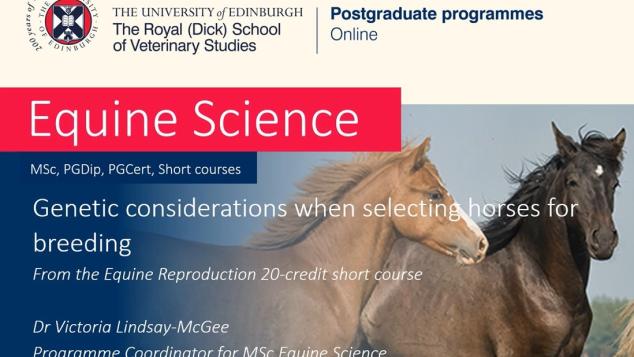
Genetic considerations when selecting horses for breeding

Dr Victoria Lindsay-McGee gives an introduction to equine genetics, and discusses some considerations relating to health and reproductive physiology in this online presentation kindly supplied by The University of Edinburgh - The Royal (Dick) School of Veterinary Studies. The lecture forms part of the Royal Dick's Equine Reproduction course.

Talk
Antimicrobial Resistance: Time for Change
Veterinary

Alles ist gut 2024: Time for Change

Professor Celia Marr discusses antimicrobial stewardship and how the Thoroughbred breeding industry can play its part in safeguarding the efficacy of these hugely important drugs.
Professor Marr also explores the impact of helminths and common veterinary medications on the gut microbiome.

Talk
When Germs Meet Worms
Veterinary

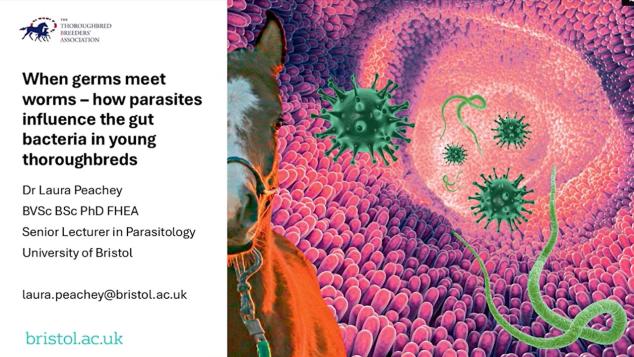
Alles ist gut 2024: When Germs Meet Worms

Dr Laura Peachey, Senior Lecturer in Veterinary Parasitology, University of Bristol, discusses how parasites influence the gut bacteria in young Thoroughbreds at the Thoroughbred Breeders' Association's educational event "Alles ist Gut".

Talk
Alborada Well Foal Study: How the foal's gut bacteria influence long-term health and performance
Veterinary

Alles ist gut 2024: How the foal's gut bacteria influence long-term health and performance

Professor Chris Proudman, Head of the University of Surrey Vet School, discusses findings from his recently published study which points to the potential of a racehorse found by analysing bacteria in a month-old foal’s gut.
Researchers at the University of Surrey analysed 438 faecal samples from 52 foals, who eventually went into training at 27 different stables in Britain and tracked veterinary issues and racecourse performance from birth to the age of three.


Talk
Veterinary

Physiotherapy and rehabilitation techniques for the convalescing or transitioning thoroughbred - when and where is it possible?

Vet consultant Jodie Daglish from Newmarket Equine Hospital talks about physiotherapy and rehabilitation techniques for the convalescing or transitioning thoroughbred at the TBA Bloodstock Conferen